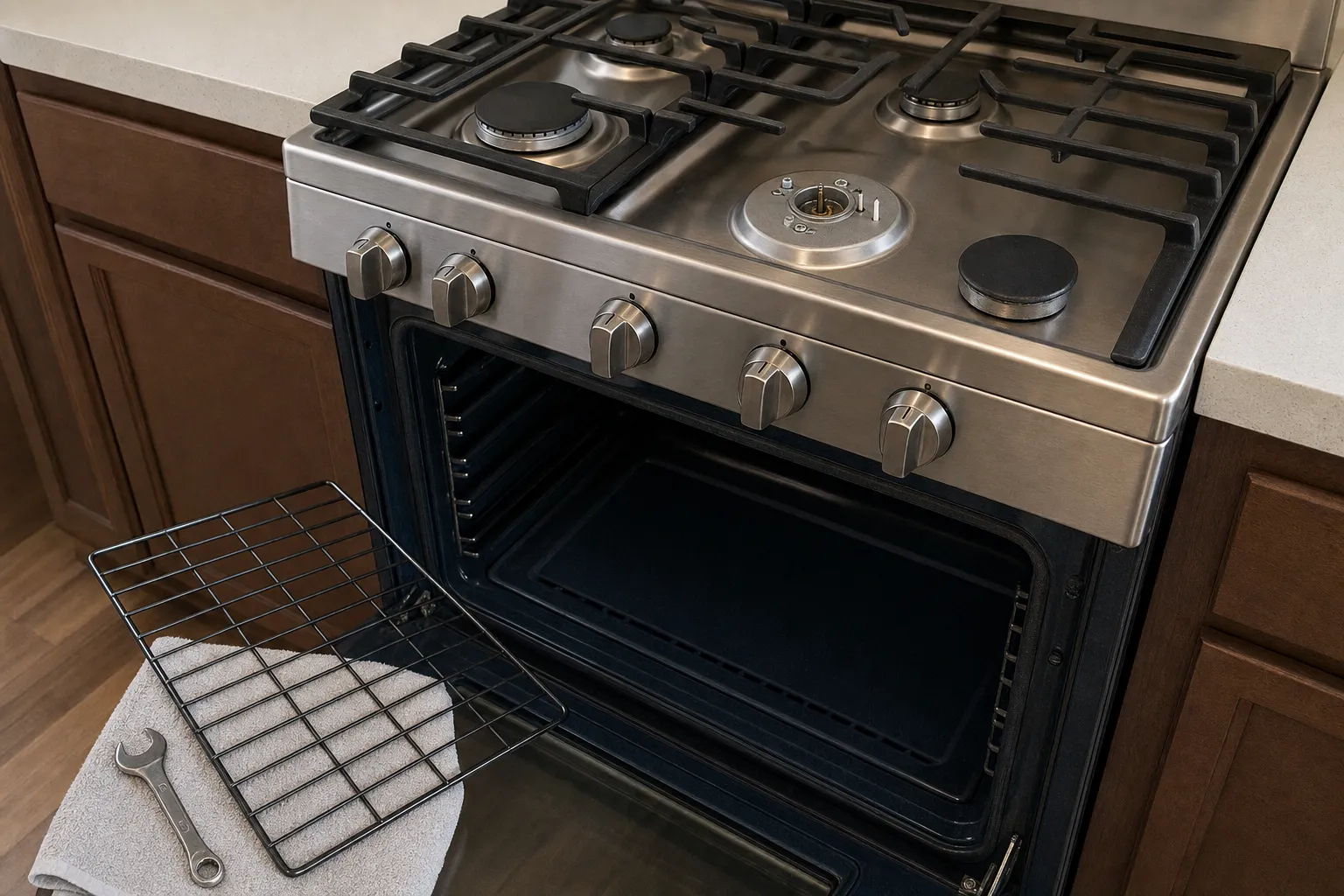
Wolf Range Hood Repair
Self-Clean in a 95-Degree Kitchen: Running a Wolf Oven Through a Puget Sound Heat Event
Running an oven self-clean cycle in an unconditioned kitchen puts hours of waste heat into a room whose hood was drawn for a 30-inch range. Where a Redmond kitchen has been rebuilt inside its original footprint, that is why the hood gives out before the oven does.
- Written by
- Greg Lindqvist
- Trade
- Cooking-appliance technician — gas ignition and burners
- Years at it
- 18
- Page dated
What a remodelled kitchen inherits
A great many Redmond kitchens are rebuilt inside the walls they already have. The cabinets, the worktop and the appliances are all new; the framing, the joist direction, the soffit and the hole the duct already goes through are treated as fixed, because moving any of them means opening the ceiling. That is a specific constraint with specific consequences.
A kitchen drawn decades ago was drawn around a 30-inch freestanding range and, very often, a hood that recirculated or vented through the shortest path available. It was not drawn around a 36 or 48 inch Wolf rangetop, and it was certainly not drawn around what that appliance can produce. The appliance changes; the duct rarely does.
Where a kitchen and its extract were specified together — a newer house whose whole suite went in at once, or a flat whose run belongs to the building — the duct at least started out matched to the appliance. A retrofit inherits whatever was already there, and that is the case this guide is about.
How that reaches the appliance
Now put a self-clean cycle into that room on a day your kitchen has climbed into the nineties.
Self-clean is the most demanding thing an oven does — a locked door, hours at the highest temperature the appliance is built to reach, and no pause anywhere in the middle of it. All of that energy has to go somewhere, and a share of it leaves through the vent and through the appliance body straight into the room. In a kitchen without air conditioning, on a day the room was already hot, nothing removes it.
That makes the hood the relief path, and in a retrofit kitchen the hood is the weakest link in the chain. A duct sized and routed for a modest domestic range is now being asked to carry the load a professional cooking surface produces during ordinary use, and to help with a multi-hour thermal event on top of it. Add elbows squeezed around framing nobody wanted to move, a transition that necks down at the ceiling penetration, and a blower that has been quietly grease-loading for years.
The appliance has its own defences and they are also being taxed. The cooling fan that protects the control electronics behind the trim is drawing hot room air to do it, and its effectiveness drops as ambient rises. So does the margin on every thermal protective device in the cabinet.
What tends to give first
The hood blower is where we see it first here. A motor already carrying a grease-coated, slightly unbalanced wheel, run for hours in a hot room, will either trip its own thermal protection and stop mid-cycle or come back noisier than it went in. The classic sequence is that the fan barely pulls smoke off the cooking surface any more, then it starts howling on the top speed, then it stops.
On the oven, the door latch assembly is the first mechanical casualty — a motor and switch that live in the hottest part of the trim and move twice a year. A latch that fails to complete its travel leaves the oven either locked or refusing to start.
Then the protective devices. Thermal limits exist to open when the surrounding cabinet exceeds a threshold, and a hot kitchen, a blocked vent path or a stalled cooling fan will find them. That produces the most common post-cycle call: an oven that will not heat at all afterwards, with no obvious damage anywhere.
After that, sensor drift and the control board, and the door seal and hinges, which take both the mechanical cycling and the heat. Lighting faults — flickering, a dead bank, a buzz — are a separate circuit and usually unrelated to any of this.
What you can check yourself
Clean the hood before you run the cycle, not after. Degrease the baffle or mesh filters properly and look into the blower housing with a torch. If the wheel blades carry a film, that is airflow you have already lost, and the cycle is the worst possible time to discover it.
Clear the oven completely, racks included unless your manual states they are rated to stay in. Clear the vent path across the top of the appliance too; a stack of trays leaning against the trim blocks exactly the air the cooling fan needs.
Make sure the door shuts square and the latch travels freely before you start anything that locks itself.
Then pick your moment: late evening, kitchen not needed, hood running, a window open in the room for make-up air. A powerful hood in a sealed house can only extract as much as the room is able to let back in, and that constraint bites hardest when the room is already hot.
If the cycle stops early or the oven is dead afterwards, do not start it again to see what happens. Something opened for a reason, and forcing the issue is how a modest repair turns into a board replacement.
What a visit settles
A visit separates the hood problem from the oven problem, which is not obvious from the kitchen when both went wrong the same afternoon. On the hood we check filter and wheel condition, motor current draw and bearing noise, the speed control, the damper and the duct route including its elbows and any transition that necks down. On the oven we test the latch and its switches, the thermal devices, the cooling fan, and the temperature sensor against a measured cavity reading, and we look at seal and hinge condition before a board is ever suspected.
What the work costs: the oven repairs above each have a published price band on the oven repair page, from sensor work up to a control board. Hood blower work has no band of its own and is quoted after the diagnosis. Either way you hear one figure before anything is ordered.
The visit itself is $89, credited to the repair if you go ahead. Ring Redmond Wolf Repair on (425) 905-2822, or book online, and say whether the trouble began during a self-clean cycle: that points at a different set of parts than a fault that turned up during ordinary cooking.
Common follow-ups
Should I run a self-clean cycle during a Redmond heat wave?
It is the worst time to choose. The cycle pours hours of heat into a room that is already hot and that many kitchens here have no way to cool, and it eats into the appliance's own thermal margin too. If it must happen in summer, run it late in the evening with the hood on and a window open. Better still, wait for a cooler week.
My hood stopped pulling and my oven will not heat after a self-clean. Are those related?
Usually two separate faults with one trigger. The heat exposed a blower that was already grease-loaded and out of balance, and it found a thermal device or a tired door latch on the oven. Neither means the expensive parts are gone, but they are diagnosed separately: a hood blower and an oven control share nothing electrically.
Why does a 48-inch Wolf rangetop overwhelm a hood that used to be fine?
Because the hood was chosen for the appliance that stood there before. Where a kitchen is rebuilt inside its original footprint, the duct route, its length and its elbows are usually inherited, since changing them means opening the ceiling. A bigger cooking surface makes far more heat and vapour, but the duct carries only what its geometry allows.